

HEXEN
Hexes of the Deadwood Forest, by Agnieszka Szpila (trans. Scotia Gilroy)

A big book club week this week and there was a LOT to discuss with Agnieszka Szpila’s absolutely wild HEXES OF THE DEADWOOD FOREST.
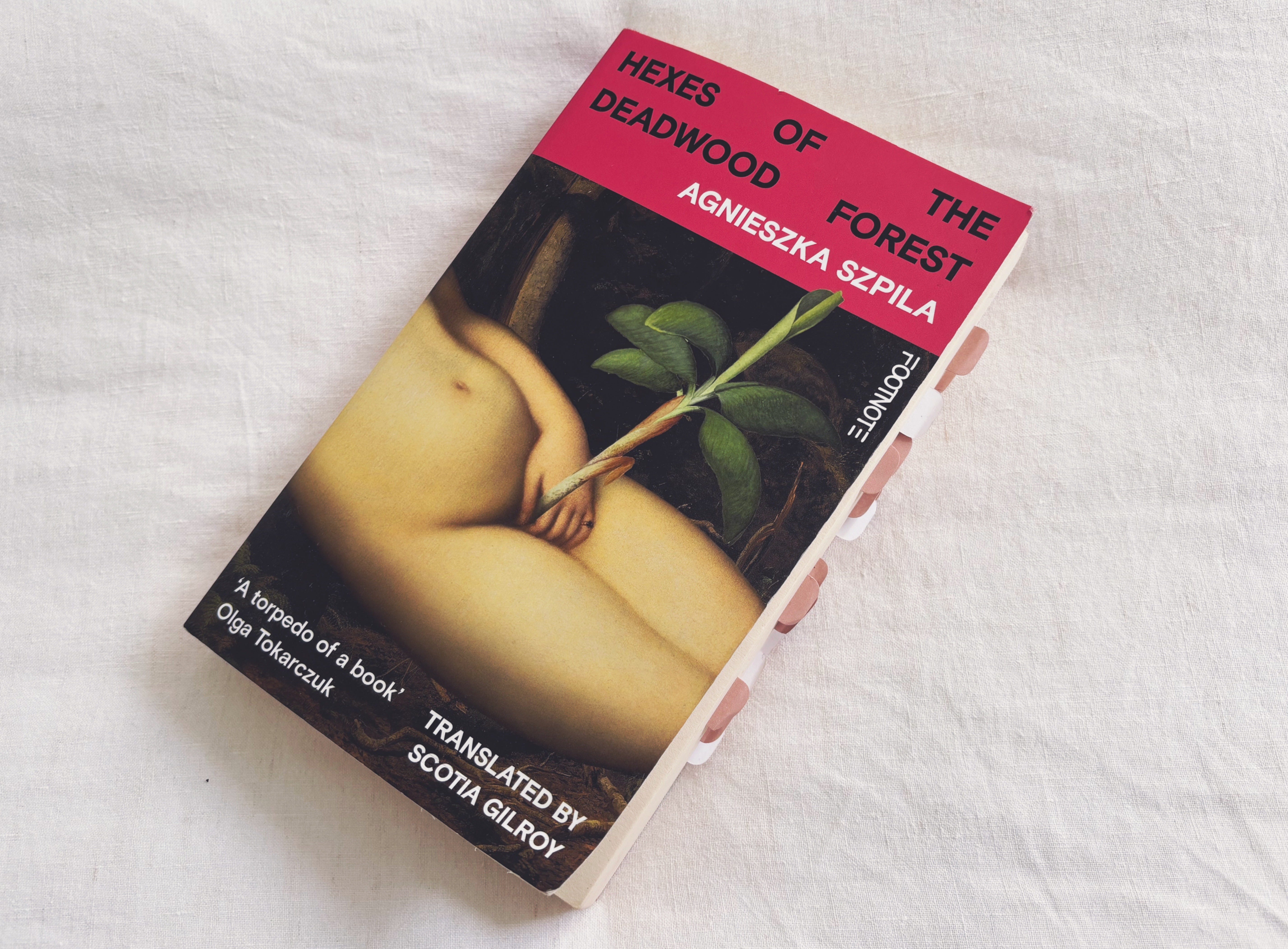
Anna Frenza hates the tyrannical tree huggers and the idiotic eco-warriors, after all, she's the CEO of Poland's biggest oil company. But then she finds herself in a trance, sleepwalking into the woods and making love to a tree, manically, all caught on camera. Her career ends and, in the fallout, she discovers her husband's disturbing secret. Her mind splinters and whether by delusion or possession of spirit, she finds herself in medieval province ruled by the Catholic Church.
Deep in the past, Anna falls in with Mathilde Spalt, leader of the Earthen Ones-a congregation of women who live in the woods and reject all patriarchy, instead engaging in ecstatic, sensuous worship of Mother Earth and learns to love the forest . . . until the Church decides to fell the forest and all the women within it.
Bold and entirely unexpected, Hexes of the Deadwood Forest is a collective rebellion and a collective orgasm, the death knell to the elevation of the erect. Take hold of your seat; patriarchy is coming to an end.
Spoilers ahead!
Look, I’ll be honest. I was nervous about this one. I was 100 pages in before I stopped repeating ohmygodwhathaveIdone over and over to myself as I read.
I did find the opening section — Anna Frenza’s horrendous anti-feminism; her sleepwalking activities; her husband Bartek’s betrayal; her response to it — hard to get into. Anna Frenza is, frankly, pretty awful, and I wasn’t sure how I would go with 300 more pages of her. Thank god(dess?!) for Kunegunde Kreppel. As soon as we were in the monastery, I found the narrative much easier to get into. I loved the 1600s setting, and I was glad to be spending much more time there than with Anna Frenza in her present-day-but-not-quite, but some people felt the opposite, and were glad to get out of the 1400s and back to Anna in the end.
We were all agreed on one thing: for a book with so much sex, it is not a sexy book.

Without tooooo many spoilers, the end section really reminded me of Marge Piercy’s WOMAN ON THE EDGE OF TIME, where a woman who can time travel into alternate realities, and finds herself in a psychiatric unit as a result. It’s purposely ambiguous as to whether she has actually visited these other places and had these other lives, or if she is actually just very mentally unwell. There are other factors involved, in that she is a poor woman of colour, with a history of mental illness, and lots of other things. Women have to be punished for creating alternate matriarchies, even in their own minds!1
It’s interesting to end a book with a manifesto, and I think it was a pretty even split on loving the end and being a bit mystified by whose manifesto it was meant to be: the new Earthen Ones? Anna Frenza and Mathilde Spalt? Helene? the author?
-
The ghosts in Hexes of the Deadwood Forest are the Earthen Ones — spirits of the past seeking opportunities to survive on devastated land. I strongly believe that these kinds of spirits come for us in the present, capturing us, abducting us, at the moment of our greatest crisis — when our identity cracks, as in Anna Frenza’s story. That’s why all the Earthen Ones share the surname SPALT (which means crack or cleft in German). They need a cleft to get through the reality we so firmly believe in, the reality so thoroughly programmed by politics, repetitive media narratives, religion and culture — and to spread their knowledge within us. What kind of knowledge, you might ask? How to survive. Is there any knowledge more urgently needed in the age of climate catastrophe and geopolitical crisis, in a world ruled by rodkins such as Trump, Putin and Netanyahu — a world of what juts upward, rigid and hard, when it should be spreading outward? Like the rhizosphere. Like mycelium. The Earthen Ones are guides through the devastated world of capitalist ruins.
Agnieszka Szpila in conversation with Scotia Gilroy, Debutiful
-
The juxtaposition of the powerful cleft (sorry) and the comical rodkins was a favourite part of the book - especially in how Frenza’s relationship with Bartek is portrayed in the beginning. She really has taken on the role of the masculine in all aspects of her life, and her husband withholding sex from her but then finding pleasure on his own is the thing that tips her into action. It’s an interesting balance, then, with the Earthen Ones who - it seems - are more like Bartek; withholding sex from their partners, but also wielding it as almost their only means of power.
We also talked about the idea of a matriarchal society but not a maternal one. The ultimate goal for the Earthen Ones isn’t to replace patriarchy with a matriarchy; it’s to replace it with no human society at all, and let the Earth be reclaimed by nature.
-
From all of our conversations a couple of weeks ago about MADAME BOVARY and it’s various translations, I was also thinking a lot about the translation of HEXES as I read, and I love this part of the interview between Scotia Gilroy and Agnieszka Szpila…
But you’re asking me something more personal than that — whether I, as the translator-alchemist, have been transformed, myself, through the work of transmuting your text. Before beginning any translation, I always read the work deeply, aiming to get the author’s voice into my bloodstream. Every text I translate leaves some mark on me, becoming something I carry around with me afterwards. And Hexes of the Deadwood Forest is such a wild, incandescent, ferociously imaginative book that it burned its way into my imagination in a way I still feel. Its restless energy passed through me during the intense days and nights I spent with it, leaving a trail of its luminous vitality. But this is all quite hard to express in words. If you hand me a piece of fabric, Agnieszka, perhaps I’ll embroider my answer more clearly for you… like your indomitable, silent Helene.
Speaking of Helene’s embroidery - I loved imagining her so angry (and mute) that she was wildly embroidering her argument on every scrap of cloth she could find. The image of her ripping off her knickers to embroider insults to show other people is hilarious. The book is, I think, much funnier than expected.
-
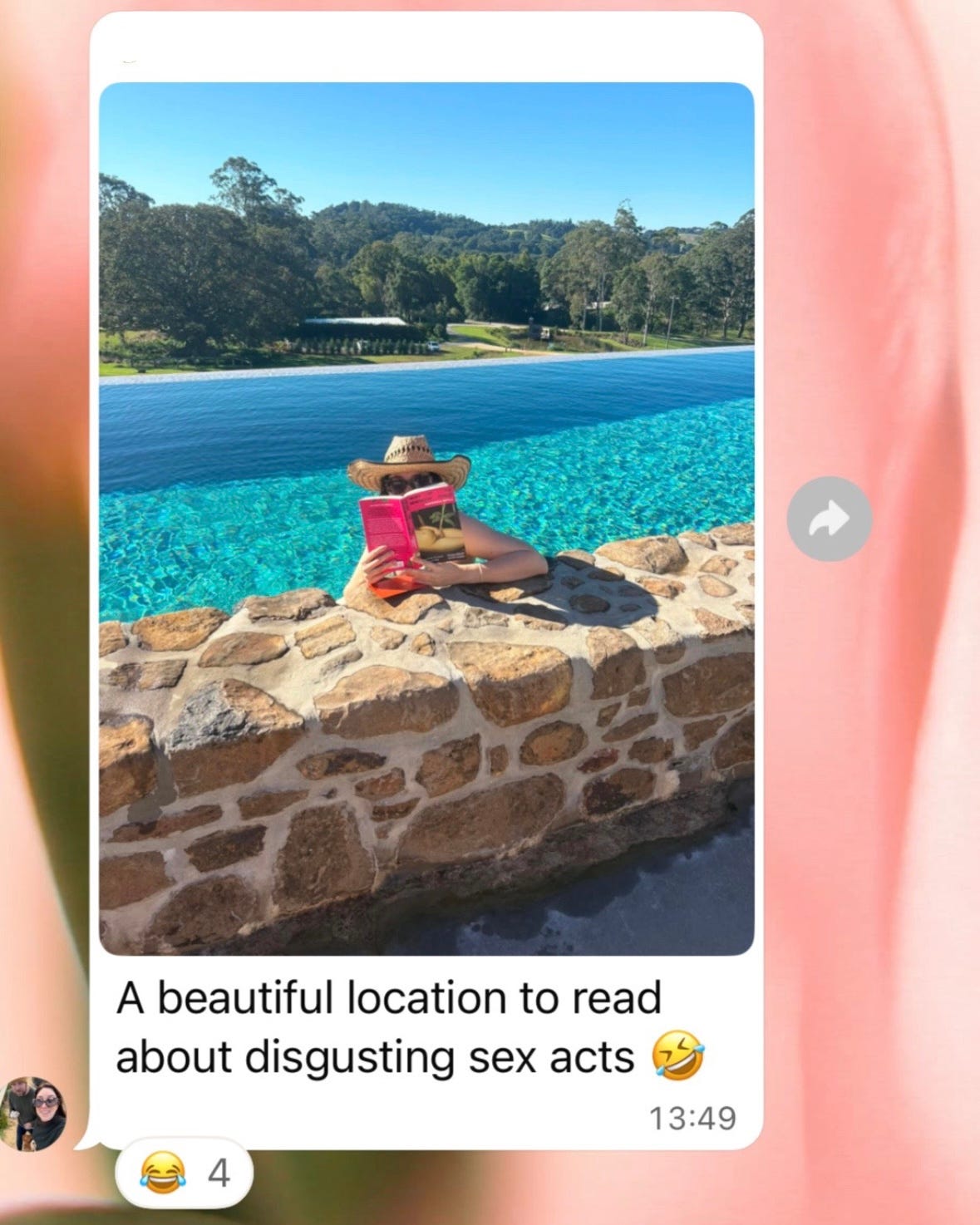
Have you read HEXES OF THE DEADWOOD FOREST? What did you think?
Other things our bookclubbers are reading and recommending this month…2
NOTES OF A CROCODILE, by Qiu Miaojin // ON EARTH WE’RE BRIEFLY GORGEOUS, by Ocean Vuong // COLLECTED STORIES, by Lydia Davis // WHISTLER, by Ann Patchett // THE WOMEN ARE NOT FINE, by Hope Reese // LONDON FALLING, by Patrick Radden Keefe // PASSING, by Nella Larsen // THE WILL OF THE MANY, by James Islington // WHY WE SLEEP, by Matthew Walker // WORDS WILL BREAK CEMENT, by Masha Gessen // A GREAT ACT OF LOVE, by Heather Rose // TRUFFLE HOUND, by Rowan Jacobson // THE WALL, by Marlen Haushofer // YESTERYEAR, by Caro Claire Burke3 // PENANCE, by Eliza Clark // THE LIVES OF OTHERS, by Neel Mukherjee // SLOUCHING TOWARDS BETHLEHEM, by Joan Didion // FIRST NAME SECOND NAME, by Steve MinOn // SWIMMING HOME, by Deborah Levy // THE RENOVATION, by Kenan Orhan // THE COMING WAVE, by Mustafa Suleyman // SAID THE DEAD, by Doireann Ní Ghríofa // KINDRED, by Octavia Butler // AUTUMN, by Ali Smith // THE PICTURE OF DORIAN GRAY, by Oscar Wilde // STRANGERS, by Belle Burden
In July, we’ll be reading NYMPH, by Sofia Montrone. You’ll find dates and details here.
I wrote about WOMAN ON THE EDGE OF TIME for my MSc thesis, and I always want to talk about it.
What a list we’ve got this month!
(x3!)
I completely agree, the book was so much funnier than expected! It actually was THE perfect book club book as an epic post-read debrief is almost mandatory for Hexes I feel 🤣